«Safety is always our top priority» — Head of Racing Dennis Schiergen on animal welfare at White Turf
The White Turf on the frozen Lake Moritz is unique worldwide. Dennis Schiergen, Head of Racing at the White Turf St. Moritz and himself a former jockey, explains how the horses are prepared for the special conditions and what safety precautions are in place.
Horse racing on a frozen lake is spectacular and differs significantly from racing on a classic racetrack. How are the horses prepared for these special conditions?
Preparation begins long before arrival in Moritz. The horses are specifically prepared by their training stables for the special requirements, for example, regarding endurance and sure-footedness. The interaction between horse and driver is also intensively trained. It is also important that the horses cope well with the special conditions. Not every horse is equally suited for racing on snow.
How is it determined whether a horse is suitable for racing on snow?
Crucial factors include how confidently a horse moves on the unfamiliar surface and how well it copes with the conditions.. The trainers know their horses very well and can assess whether a start on snow is suitable for them..
What special requirements are there for horses' hooves and shoeing on snow and ice?
On snow, horses need specially designed shoes to ensure the best possible grip. For all starters in flat races, spiked horseshoes are mandatory to guarantee the necessary traction. These must meet the association's standards. Crucially, they must be optimally adapted to the specific conditions on snow.
What medical checks does a horse undergo before it is even allowed to compete in the White Turf?
Each horse is examined by an independent veterinarian nominated by the association before its start. This veterinarian can withdraw a horse from the start at any time based on their independent assessment.
How is veterinary care organized during a race day?
During race days, we have a specialized veterinary team on site. Crucial here is not only the number of veterinarians, but also their positioning and clear division of tasks. The horses are observed at the start, during the race, and afterwards. Should anything happen, we can react very quickly.
What exactly happens if a horse is injured during a race?
For such cases, a specialized team is on hand. This includes veterinarians from the Zurich Animal Hospital, the Large Animal Rescue Service (GTRD), and a veterinarian from the association. During the races, a veterinarian accompanies the field on a snowmobile and can react immediately in case of an accident. Additional veterinarians are positioned at the edge of the racetrack so that an injured horse can receive care as quickly as possible. If necessary, the GTRD is also called in for the safe transport of the horse.
With which external experts and institutions does White Turf collaborate on the topic of animal welfare?
We work closely with external specialists and institutions, in particular the Zurich Animal Hospital and the Office for Food Safety and Animal Health of the Canton of Graubünden (ALT). They contribute their veterinary and professional expertise and support us in ensuring the welfare of the horses.
A key point is of course the ice. How do you ensure that the conditions on Lake Moritz are safe for horse and rider?
The ice and snow conditions are continuously monitored before and during the event using various methods. These include radar measurements and a drone equipped with an infrared camera. This allows us not only to measure ice thickness but also to identify potential weak points or moisture between the ice and snow cover. Additionally, we conduct test drillings at relevant locations. The results are evaluated by experts, and the racecourse is prepared or the track layout adjusted accordingly. If safety cannot be guaranteed, no races will take place.
Is there a prescribed minimum ice thickness, and is the thickness alone sufficient to assess whether the ice is safe?
A minimum ice thickness of 28 cm is required for the construction of the Time City. Typically, the ice in the racetrack area is between 50 and 80 centimeters thick and is covered by approximately 50 centimeters of compressed snow. However, ice thickness is only one factor. Crucial factors also include the condition of the ice and the snowpack, as well as any weak points or moisture between the layers. Therefore, we monitor the racetrack using various methods, including radar, drones, and exploratory drilling. Only when the overall picture is satisfactory and the specialists have given the track the green light do races take place.
Who ultimately decides whether the racetrack is safe enough to hold a race?
On the morning of each race day, the racecourse is thoroughly inspected by See-Infra together with the experts from Geo Grischa and Dr. Felix Keller. Only when they have given the go-ahead is the track handed over to the White Turf . The go-ahead is therefore based on an independent expert assessment.
What happens if the conditions are generally sufficient, but doubts exist?
Then the races will be cancelled. Safety is non-negotiable and our top priority.
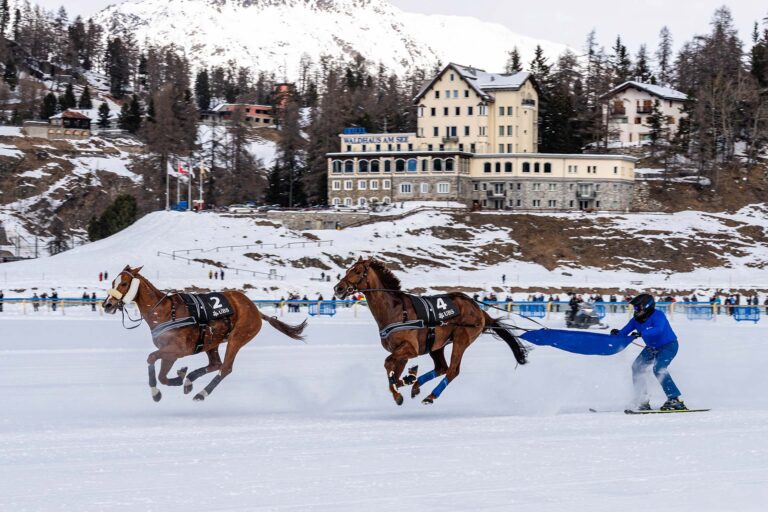
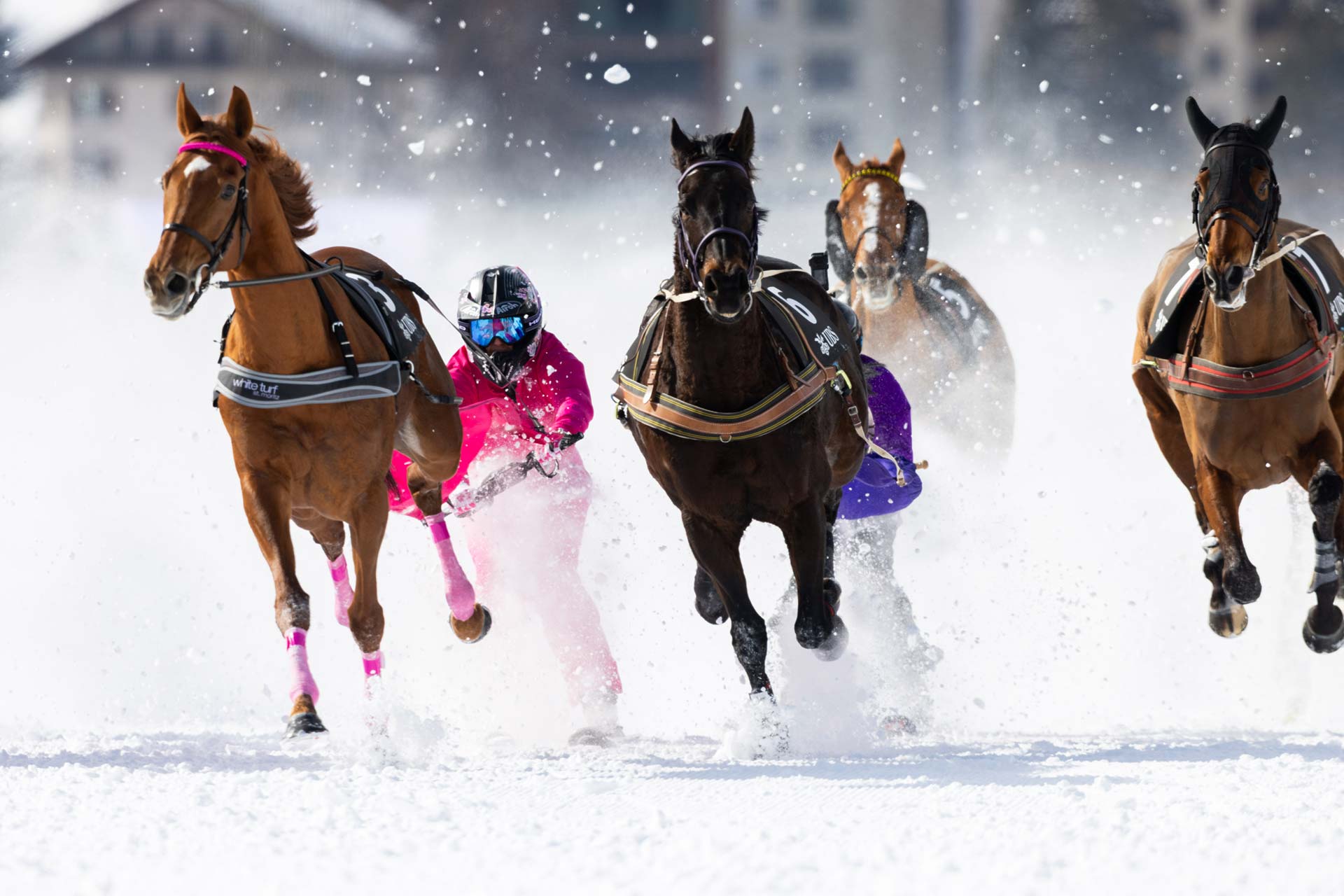
The Skikjöring is the most exceptional discipline of the White Turf.. What special safety requirements does it entail?
Skikjöring places special demands on both horse and driver: The horses are therefore specifically trained for this discipline. Additionally, an inspection by the Skikjöring- commission takes place the day before the first race Sunday. Every horse must pass this inspection to be eligible to race, and this eligibility is reviewed annually. This also applies to the drivers, who must pass a licensing exam. This exam must be repeated if a driver has not raced for two consecutive years.
Since 2025, a newly developed high-tech - cookware has been used at .. How does this system work?
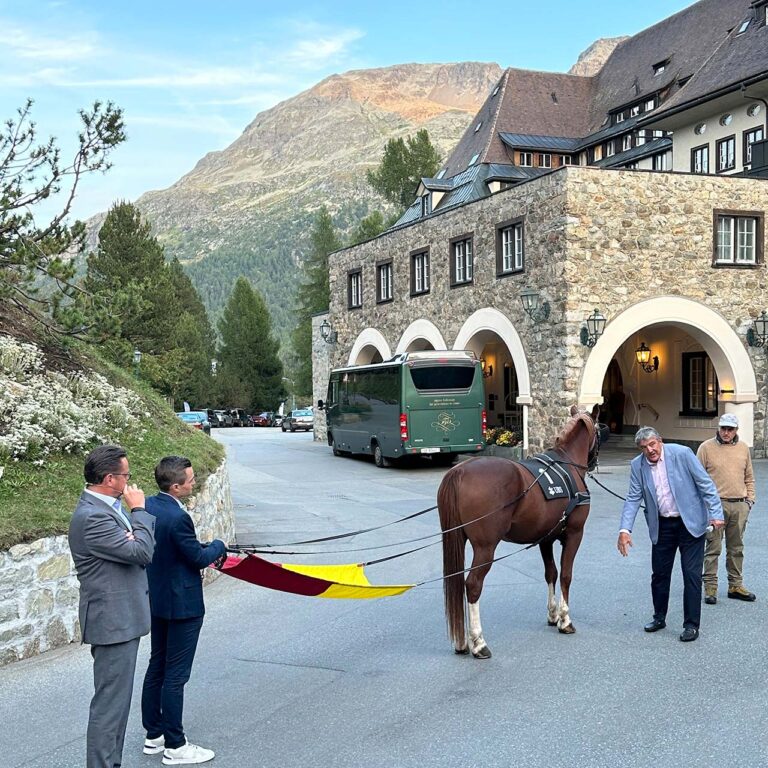
Falls can occur in horse racing, just like in skiing, where the horse then continues running without the rider. Therefore, we have developed a new safety system together with specialists. As soon as the connection between human and horse is broken, a so-called kill switch is triggered: the leads and reins are automatically disconnected from the harness and fall to the ground. This reduces the risk of the horse or other race participants becoming entangled in them.
Critics argue that horse racing on a frozen lake is fundamentally an unnecessary risk to the animals. What do you say to that?
I understand that people have such concerns. That's precisely why it's important to explain the comprehensive controls and safeguards behind the races. We do everything to ensure the safety of the horses and never take unnecessary risks.
During the White Turf 2026 event, a horse had to be euthanized after a fall. . What does such an accident mean to you and what consequences do you draw from it?
Such an accident is very tragic for us and everyone involved. Fortunately, serious accidents in horse racing are extremely rare. At the same time, we know that risks in horse racing can never be completely eliminated. This makes it all the more important for us to do everything we can to minimize these risks as much as possible. That's why we take comprehensive safety measures and analyze every incident meticulously to see if further improvements are possible. The welfare of the horses and jockeys is always our top priority.